
Lean for TypeScript developers
Lean is a programming language that can also check proofs. You write a function, then you write a claim about it (“the result is never negative”), and Lean checks that the claim holds for every possible input. Not for the inputs you thought of. For all of them.
This page shows how to use it next to a normal TypeScript project, with one small example. No math background needed.
Why you would want this
Section titled “Why you would want this”Unit tests check the cases you wrote. Here is a normal discount function and two normal tests:
Note:applyDiscount is a pure function: same inputs, same output, and no side effects.
export function applyDiscount(priceCents: number, percent: number, capCents: number): number { const discount = Math.min(Math.floor((priceCents * percent) / 100), capCents); return priceCents - discount;}test('20% off 50.00', () => { expect(applyDiscount(5000, 20, 10000)).toBe(4000);});
test('discount is capped', () => { expect(applyDiscount(5000, 50, 1000)).toBe(4000);});Both tests pass. The function still has two bugs:
- A
percentover 100 (for example, two coupons used together) makes the price negative:applyDiscount(5000, 150, 10000)is-2500. - A negative
percent(a bad value from an admin form) makes the price go up.
applyDiscount(5000, 150, 10000) is -2500.A test only finds these if someone thinks to write that exact case. Lean finds them because it has to cover every case, so it gets stuck on the ones you missed.
When Lean fits
Section titled “When Lean fits”- Pure functions with rules that must always hold: prices, fees, limits, rounding, permissions, date ranges, parsers.
- The function is small, and a wrong answer costs real money or trust.
- You can say the rule in one sentence: “the price never goes below zero”.
Lean is itself a pure functional language. A pure TS function (same inputs give the same output, no mutation, no
I/O) copies into Lean almost line for line, as applyDiscount does below. Code written in a functional style in TS,
with map, filter, reduce and recursion instead of loops over mutable variables, is the easiest to bring over.
Code with mutable loops, classes or await has to be rewritten into pure style first. That is more work, and the
copy is more likely to drift from the original. For loops and mutation, Dafny is the closer fit.
Lean is not the tool for “what happens when two requests arrive at the same time”. That is about the order of events, not one function. See the Quint page for that.
Install
Section titled “Install”curl https://raw.githubusercontent.com/leanprover/elan/master/elan-init.sh -sSf | shCreate a Lean project in a lean/ folder inside your TS repo:
mkdir lean && cd leanlake init discount# lake init creates its own git repo and CI; the TS repo already has bothrm -rf .git .github README.mdlake buildelan installs Lean and lake. Keep the Lean project in lean/, and remove the .git and .github that lake init creates.Step 1: copy the function into Lean (use AI)
Section titled “Step 1: copy the function into Lean (use AI)”Lean does not read TypeScript. You rewrite the function in Lean, yourself or with an AI assistant. For small pure functions this is a few lines:
-- Discount/Pricing.leandef applyDiscount (price percent cap : Int) : Int :=  -- Int: a whole number of any size, in cents  price - min (price * percent / 100) cap
#eval applyDiscount 5000 20 10000   -- runs during the build, like console.log#eval applyDiscount 5000 150 10000
Step 2: write the rule, and let the proof fail
Section titled “Step 2: write the rule, and let the proof fail”Now the rule, written as a theorem: for any price that is zero or more, the result is zero or more. It goes in the
same file, below the function:
-- Discount/Pricing.lean (continued)theorem never_negative (price percent cap : Int) (hPrice : 0 ≤ price) : -- given: the price is not negative 0 ≤ applyDiscount price percent cap := by -- the claim, then the proof unfold applyDiscount -- replace the name with its body omega -- a built-in solver for +, -, < and ≤ on whole numbersRun lake build:
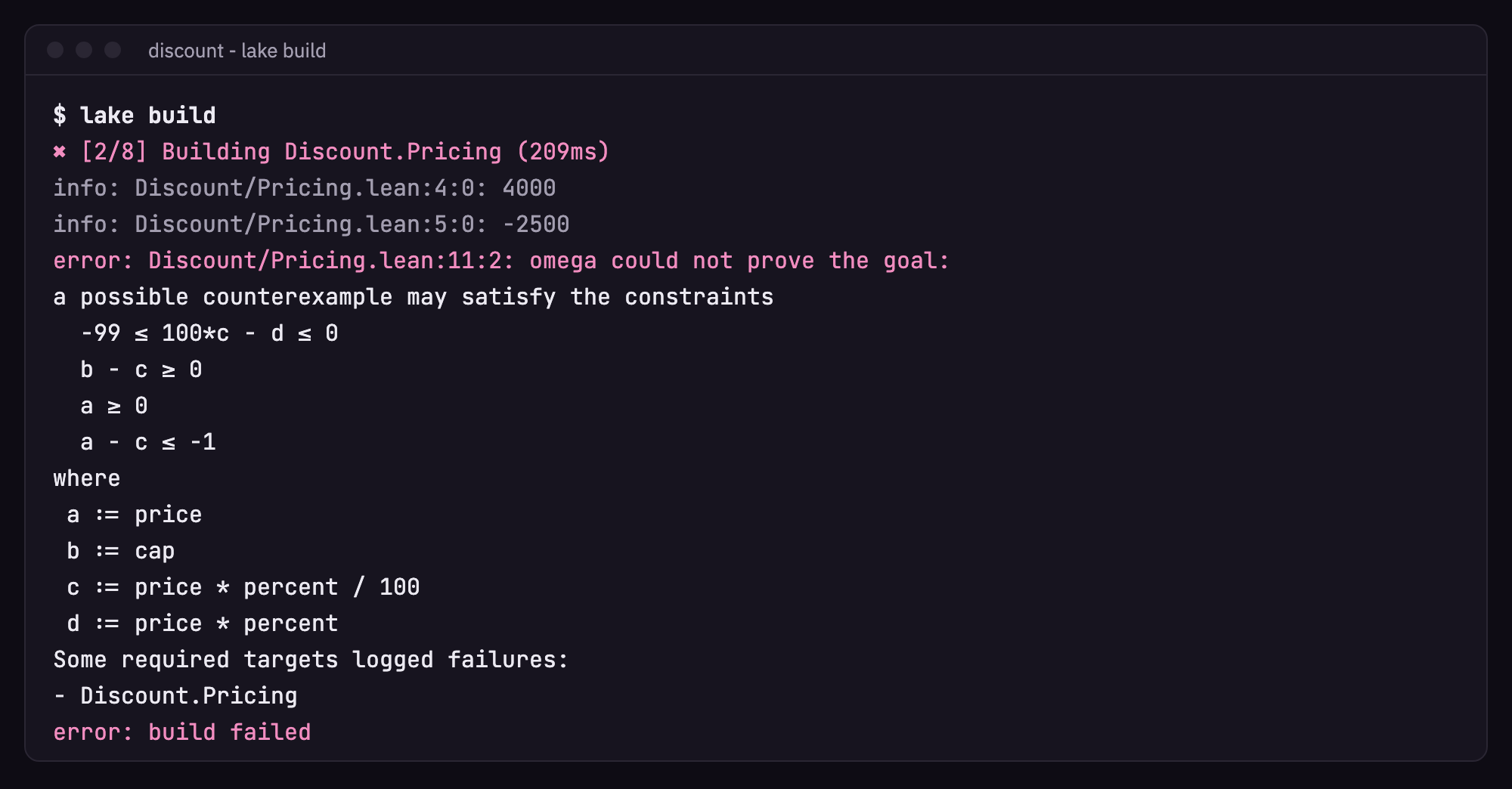
percent is over 100.This is the useful part. Lean does not just say “no”. It shows the kind of input that breaks the claim:
a := price,c := price * percent / 100(the discount).a - c ≤ -1: the discount is bigger than the price.
That happens exactly when percent is over 100. The -2500 from #eval confirms it.
Step 3: fix the function, and prove all three rules
Section titled “Step 3: fix the function, and prove all three rules”Clamp the percent to 0..100, then prove three rules: never negative, never more than the original price, and the discount never goes over the cap.
def applyDiscount (price percent cap : Int) : Int :=  price - min (price * percent / 100) cap
#eval applyDiscount 5000 20 10000#eval applyDiscount 5000 150 10000
theorem never_negative (price percent cap : Int) (hPrice : 0 ≤ price) : 0 ≤ applyDiscount price percent cap := by unfold applyDiscount omegadef clampPercent (percent : Int) : Int := max 0 (min percent 100)
def applyDiscount (price percent cap : Int) : Int := price - min (price * percent / 100) cap price - min (price * clampPercent percent / 100) cap
#eval applyDiscount 5000 20 10000#eval applyDiscount 5000 150 10000theorem discount_le_price (price percent : Int) (hPrice : 0 ≤ price) : 0 ≤ price * clampPercent percent ∧ price * clampPercent percent ≤ price * 100 := by have h0 : 0 ≤ clampPercent percent := by unfold clampPercent; omega have h1 : clampPercent percent ≤ 100 := by unfold clampPercent; omega exact ⟨Int.mul_nonneg hPrice h0, Int.mul_le_mul_of_nonneg_left h1 hPrice⟩
theorem never_negative (price percent cap : Int) (hPrice : 0 ≤ price) : 0 ≤ applyDiscount price percent cap := by have := discount_le_price price percent hPrice unfold applyDiscount omega
theorem never_more_than_price (price percent cap : Int) (hPrice : 0 ≤ price) (hCap : 0 ≤ cap) : applyDiscount price percent cap ≤ price := by have := discount_le_price price percent hPrice unfold applyDiscount omega
theorem discount_within_cap (price percent cap : Int) : price - applyDiscount price percent cap ≤ cap := by unfold applyDiscount omega
#guard applyDiscount 5000 20 10000 == 4000#guard applyDiscount 5000 150 10000 == 0#guard applyDiscount 5000 50 1000 == 4000def clampPercent (percent : Int) : Int :=max 0 (min percent 100)def applyDiscount (price percent cap : Int) : Int :=price - min (price * clampPercent percent / 100) cap#eval applyDiscount 5000 20 10000theorem discount_le_price (price percent : Int) (hPrice : 0 ≤ price) :#eval applyDiscount 5000 150 100000 ≤ price * clampPercent percent ∧ price * clampPercent percent ≤ price * 100 := byhave h0 : 0 ≤ clampPercent percent := by unfold clampPercent; omegahave h1 : clampPercent percent ≤ 100 := by unfold clampPercent; omegaexact ⟨Int.mul_nonneg hPrice h0, Int.mul_le_mul_of_nonneg_left h1 hPrice⟩theorem never_negative (price percent cap : Int)(hPrice : 0 ≤ price) :0 ≤ applyDiscount price percent cap := byhave := discount_le_price price percent hPriceunfold applyDiscountomegatheorem never_more_than_price (price percent cap : Int)(hPrice : 0 ≤ price) (hCap : 0 ≤ cap) :applyDiscount price percent cap ≤ price := byhave := discount_le_price price percent hPriceunfold applyDiscountomegatheorem discount_within_cap (price percent cap : Int) :price - applyDiscount price percent cap ≤ cap := byunfold applyDiscountomega#guard applyDiscount 5000 20 10000 == 4000#guard applyDiscount 5000 150 10000 == 0#guard applyDiscount 5000 50 1000 == 4000
def clampPercent (percent : Int) : Int :=  max 0 (min percent 100)
def applyDiscount (price percent cap : Int) : Int :=  price - min (price * clampPercent percent / 100) cap
theorem discount_le_price (price percent : Int) (hPrice : 0 ≤ price) :    0 ≤ price * clampPercent percent ∧ price * clampPercent percent ≤ price * 100 := by  have h0 : 0 ≤ clampPercent percent := by unfold clampPercent; omega  have h1 : clampPercent percent ≤ 100 := by unfold clampPercent; omega  exact ⟨Int.mul_nonneg hPrice h0, Int.mul_le_mul_of_nonneg_left h1 hPrice⟩
theorem never_negative (price percent cap : Int)    (hPrice : 0 ≤ price) :    0 ≤ applyDiscount price percent cap := by  have := discount_le_price price percent hPrice  unfold applyDiscount  omega
theorem never_more_than_price (price percent cap : Int)    (hPrice : 0 ≤ price) (hCap : 0 ≤ cap) :    applyDiscount price percent cap ≤ price := by  have := discount_le_price price percent hPrice  unfold applyDiscount  omega
theorem discount_within_cap (price percent cap : Int) :    price - applyDiscount price percent cap ≤ cap := by  unfold applyDiscount  omega
#guard applyDiscount 5000 20 10000 == 4000#guard applyDiscount 5000 150 10000 == 0#guard applyDiscount 5000 50 1000 == 4000omega cannot multiply two unknowns (price * percent), so discount_le_price uses two library facts for that
part. You find names like these by searching the docs or asking an AI assistant. Lean checks every step, so a wrong
suggestion fails the build.
#guard is a plain test that runs during the build. It is useful for a few examples next to the proofs.

A green build means all three rules hold for every whole-number input, not just the tested ones.
Step 4: let the proof tell you the preconditions
Section titled “Step 4: let the proof tell you the preconditions”Look at never_more_than_price. It needs hCap : 0 ≤ cap. Remove it and build again:
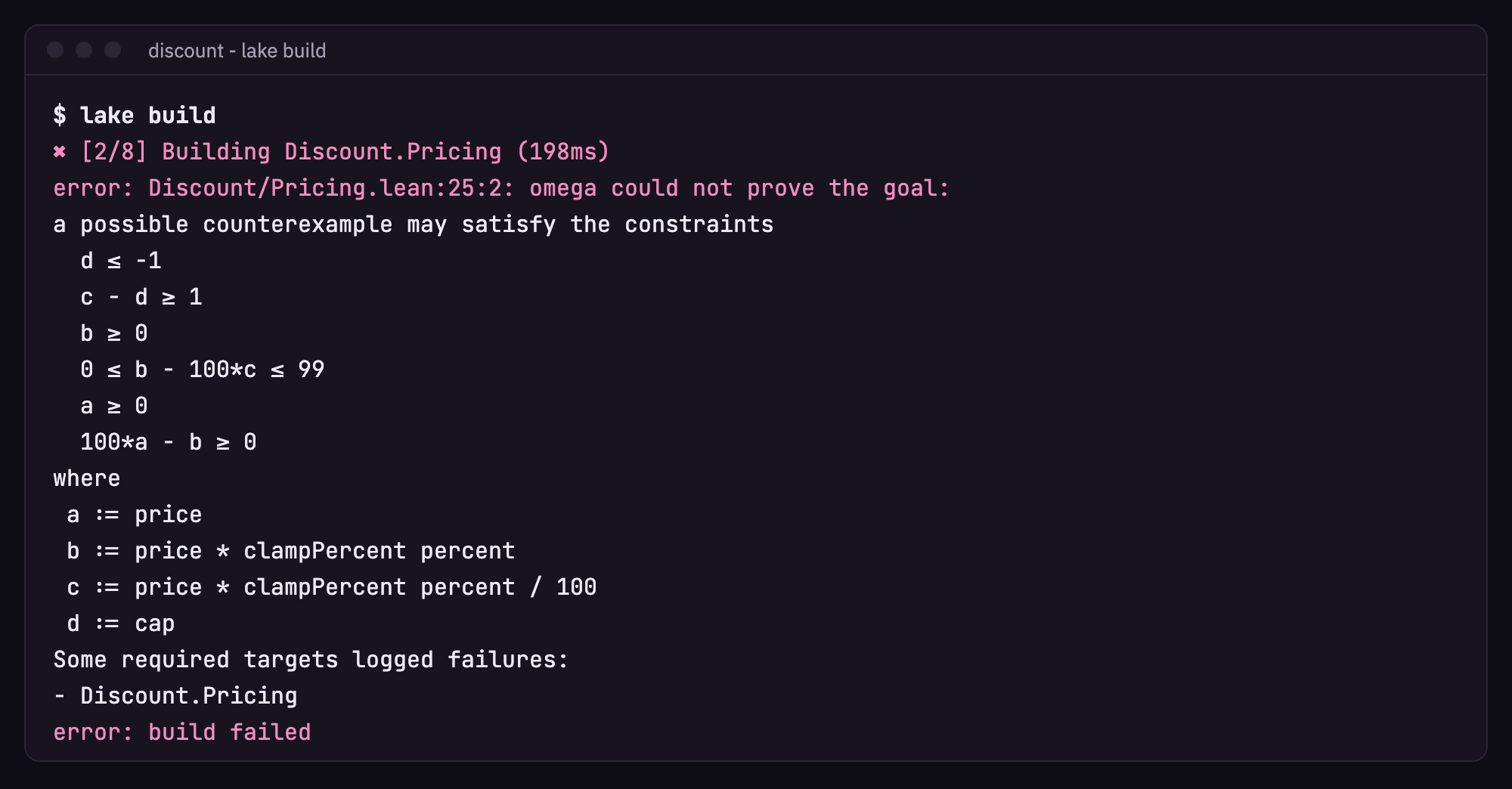
hCap the proof fails: a negative cap makes the price go up. A precondition nobody wrote down.d := cap and d ≤ -1: a negative cap makes the price go up. You now know a precondition the TS function has
today and nobody wrote down. You can clamp the cap too, or check it where the cap comes in (for example, the admin
form). This is the most common way Lean helps in practice: it makes every hidden assumption visible.
Step 5: check the TS code gives the same answers
Section titled “Step 5: check the TS code gives the same answers”The proofs are about the Lean copy. Nothing yet checks that pricing.ts does the same thing. The simplest link:
Lean computes answers for a grid of inputs, and vitest checks the TS function against them.
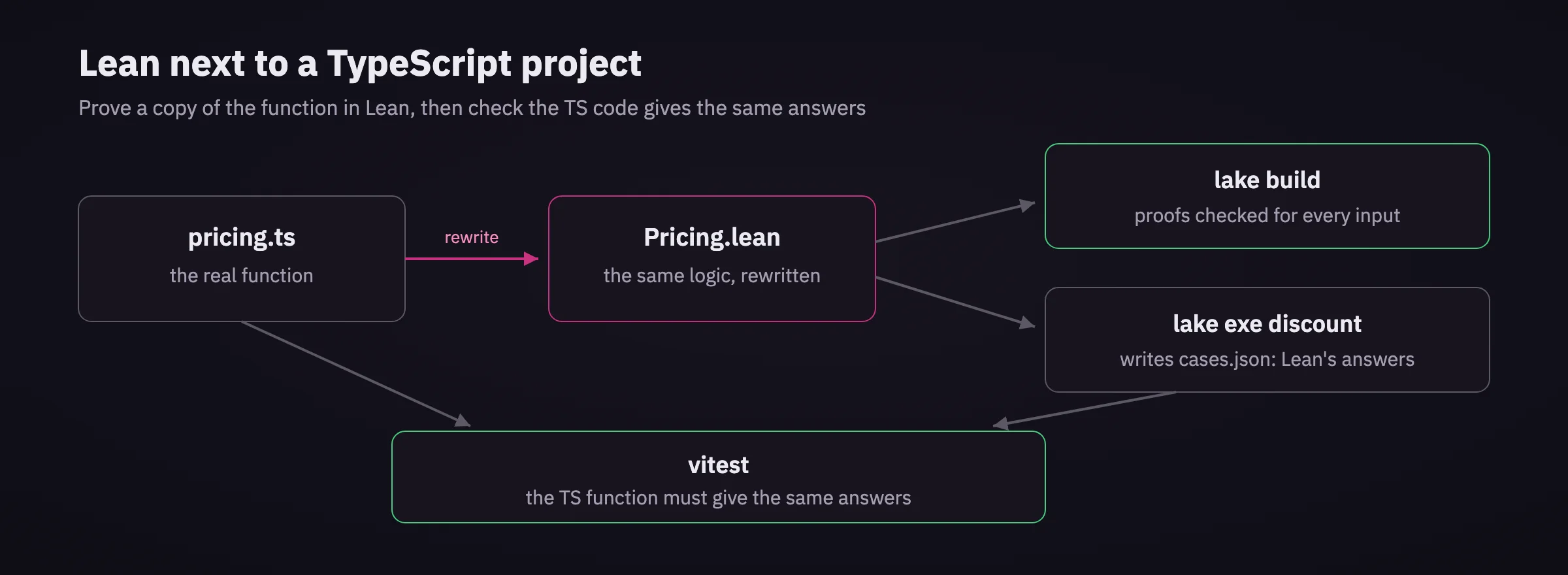
A small Lean program prints the grid as JSON. It includes the tricky values: 0, negatives, just over 100:
-- Main.leanimport Discount
def main : IO Unit := do let prices : List Int := [0, 1, 99, 100, 999, 5000, 123456] let percents : List Int := [-50, -1, 0, 1, 33, 50, 99, 100, 101, 150] let caps : List Int := [0, 1, 500, 1000, 1000000] let rows := prices.flatMap fun p => percents.flatMap fun pc => caps.map fun c => s!"[{p},{pc},{c},{applyDiscount p pc c}]" IO.println ("[" ++ ",".intercalate rows ++ "]")cd lean && lake build && lake exe discount > cases.jsonThis writes lean/cases.json. In the project it is the lean:cases script, see below.
And one vitest file reads it:
import { readFileSync } from 'node:fs';import { expect, test } from 'vitest';import { applyDiscount } from './pricing';
const cases: [number, number, number, number][] = JSON.parse(  readFileSync(new URL('../lean/cases.json', import.meta.url), 'utf8'),);
test.each(cases)('applyDiscount(%i, %i, %i) is %i, as in the Lean model', (price, percent, cap, expected) => {  expect(applyDiscount(price, percent, cap)).toBe(expected);});
Against the original, unclamped TS function, 77 of the 350 cases fail:
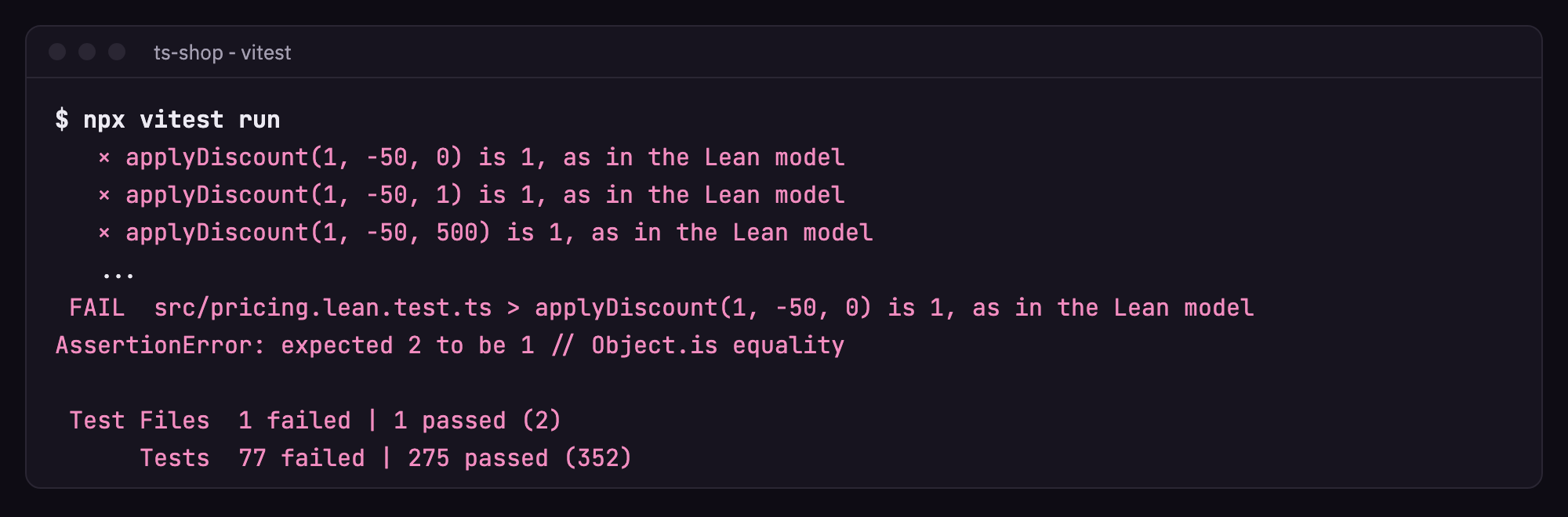
applyDiscount(1, -50, 0) returns 2 in TS: a 1-cent item with a -50% “discount” now costs 2 cents. Apply the same
clamp in TS:
export function applyDiscount(priceCents: number, percent: number, capCents: number): number { const discount = Math.min(Math.floor((priceCents * percent) / 100), capCents); return priceCents - discount;}function clampPercent(percent: number): number { return Math.max(0, Math.min(percent, 100));}
export function applyDiscount(priceCents: number, percent: number, capCents: number): number { const discount = Math.min(Math.floor((priceCents * percent) / 100), capCents); const discount = Math.min(Math.floor((priceCents * clampPercent(percent)) / 100), capCents); return priceCents - discount;}function clampPercent(percent: number): number {return Math.max(0, Math.min(percent, 100));}export function applyDiscount(priceCents: number, percent: number, capCents: number): number {const discount = Math.min(Math.floor((priceCents * clampPercent(percent)) / 100), capCents);return priceCents - discount;}
function clampPercent(percent: number): number {  return Math.max(0, Math.min(percent, 100));}
export function applyDiscount(priceCents: number, percent: number, capCents: number): number {  const discount = Math.min(Math.floor((priceCents * clampPercent(percent)) / 100), capCents);  return priceCents - discount;}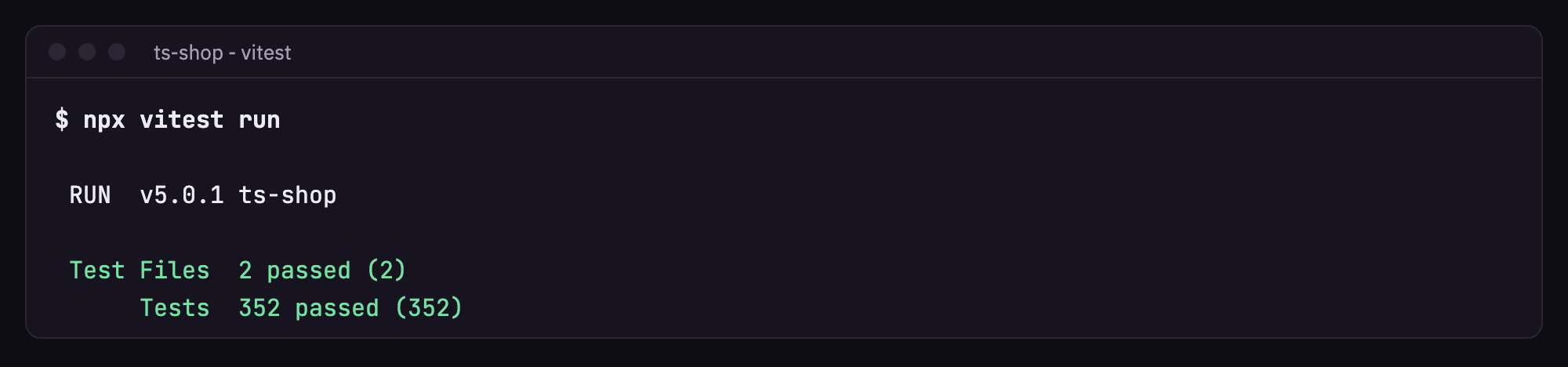
Commit cases.json. The next section shows where everything lives and how CI keeps the three parts (the TS code,
the Lean copy, the grid) in sync.
Project layout and CI
Section titled “Project layout and CI”cases.json. CI builds the proofs, regenerates the grid and fails if it changed, then runs vitest.One repo. The Lean project sits in its own folder next to src/, the way a docs/ or infra/ folder would:
./├── .github/workflows/ci.yml├── lean/ the Lean project│ ├── lean-toolchain Lean version, like .nvmrc│ ├── lakefile.toml like package.json│ ├── lake-manifest.json like package-lock.json│ ├── .gitignore ignores lean/.lake, the build output│ ├── Discount.lean library root: imports the modules below│ ├── Discount/Pricing.lean the Lean copy of applyDiscount, the theorems, the #guard lines│ ├── Main.lean prints the grid of cases as JSON│ └── cases.json generated by Main.lean, committed├── src/│ ├── pricing.ts the real function│ ├── pricing.test.ts normal unit tests│ └── pricing.lean.test.ts checks pricing.ts against lean/cases.json├── package.json└── tsconfig.jsonWho needs what:
- Everyone runs
npm testas usual. The cross-check reads the committedcases.json, so a developer who never touches the Lean code does not need Lean installed. - Whoever changes
lean/needs Lean (theelaninstall above), and regeneratescases.json.
Scripts in package.json:
"scripts": { "lean:build": "cd lean && lake build", "lean:cases": "cd lean && lake build && lake exe discount > cases.json", "typecheck": "tsc", "test": "vitest run"}lean:cases builds first. If a proof fails, the build fails, and cases.json is not overwritten with an empty
file.
The CI workflow has two jobs:
The CI workflow: .github/workflows/ci.yml (32 lines)
name: CI
on:  push:    branches: [main]  pull_request:
jobs:  lean:    runs-on: ubuntu-latest    steps:      - uses: actions/checkout@v7      - uses: leanprover/lean-action@v1        with:          lake-package-directory: lean      - name: cases.json matches the Lean model        run: |          npm run lean:cases          git diff --exit-code lean/cases.json
  ts:    runs-on: ubuntu-latest    steps:      - uses: actions/checkout@v7      - uses: actions/setup-node@v7        with:          node-version: 24          cache: npm      - run: npm ci      - run: npm run typecheck      - run: npm test
What fails when:
| Change | Where CI fails |
|---|---|
| A change to the Lean function breaks a rule | lean job, lake build: the theorem no longer proves |
The Lean function changes, cases.json is not regenerated | lean job, git diff: the grid is stale |
pricing.ts changes, the Lean copy does not | ts job, pricing.lean.test.ts: TS answers differ from Lean’s |
Both change the same way, cases.json regenerated | Nothing fails. This is a normal, reviewed change |
Making changes
Section titled “Making changes”cases.json, change the TS to match, and commit all three together.Changing the pricing rule (for example, a new maximum discount):
- Change
lean/Discount/Pricing.leanfirst. Runnpm run lean:build. If a theorem fails, decide: the new rule is wrong, or the theorem should change. Either way, the decision is now explicit in the diff. - Run
npm run lean:cases. - Change
src/pricing.tsthe same way. Runnpm testuntil the cross-check passes. - Commit all three together:
Pricing.lean,cases.json,pricing.ts. The reviewer sees the rule change, the proof change and the code change in one pull request.
Adding a rule: add a theorem to Pricing.lean. No other file changes, since a new proof does not change any answer.
Adding a tricky input: add the value to the lists in Main.lean and regenerate cases.json. When a production bug
comes from an input nobody thought of, this is where it goes, like a regression test.
Reviewing a pull request: if src/pricing.ts changed and lean/ did not, ask why. The cross-check only catches a
difference that shows up on the grid, so a matching Lean change is what shows that someone thought about the
rules.
Strengths
Section titled “Strengths”- True for every input. The rules hold for every whole-number input of the Lean copy. No test suite can say that.
- Hidden assumptions show up. A failed proof points at them, like
percentover 100 or a negative cap. - Drift is caught. The cross-check fails when the TS code stops matching the proven copy on the grid.
Limitations
Section titled “Limitations”- No proof about the TS code. The link is the grid of cases, and it is only as good as the values you put in it.
- No floating point. Lean’s
Intis exact and TSnumberis a float. For real float math the two can disagree at the edges. - Functions only. Lean does not cover timing, concurrency, I/O or the order of events.
- Some proofs are hard.
omegahandles plus, minus and comparisons. Multiplication, lists and recursion need more steps.
How to start in your own project
Section titled “How to start in your own project”- Pick one small pure function where a wrong answer is expensive.
- Write its rules as plain sentences first.
- Copy the function into Lean. Keep the same names so the two files are easy to compare.
- Write one
theoremper rule. Tryunfoldthenomegafirst. - When a proof fails, read the counterexample. It is usually a missing check in the code, not a problem with the proof.
- Add the JSON grid and the vitest cross-check, so CI catches drift.
Related
Section titled “Related”- LemmaScript: a tool that skips the manual copy. You write contract comments in the TS file, and it translates the function to Lean or Dafny for you.
- Lean documentation
- Functional Programming in Lean: the book for programmers, not mathematicians.
- Theorem Proving in Lean 4
- Lean4 and the Curry-Howard Isomorphism, a talk by Luis Wirth: why a proof in Lean is a program, and a rule is a type.