
Dafny for TypeScript developers
Dafny is a programming language with a checker built in. Next to the code you write what the
function needs (requires) and what it promises (ensures). Dafny proves the promise holds for every input, and
only then compiles the code. It can compile to JavaScript, so the code you proved is the code you ship.
This page shows how to use it inside a normal TypeScript project, with one small example. No Dafny experience needed: a coding agent can write the Dafny, and the verifier checks every line of it.
Why you would want this
Section titled “Why you would want this”indexOfId([10, 20, 30], 10) returns -1.Here is a normal binary search over sorted ids, and two normal tests:
Note:indexOfId is pure from the outside (same inputs, same output, no side effects), but it loops over mutable local variables inside. Dafny proves that as written.
export function indexOfId(ids: readonly number[], target: number): number { let lo = 0; let hi = ids.length - 1; while (lo < hi) { const mid = Math.floor((lo + hi) / 2); if (ids[mid] < target) lo = mid + 1; else if (ids[mid] > target) hi = mid - 1; else return mid; } return -1;}test('finds an id', () => { expect(indexOfId([10, 20, 30], 20)).toBe(1);});
test('returns -1 for a missing id', () => { expect(indexOfId([10, 20, 30], 25)).toBe(-1);});Both tests pass. The function still has a bug: indexOfId([10, 20, 30], 10) returns -1, and so does
indexOfId([10, 20, 30], 30). When the search narrows down to one last element, the loop stops before looking at it.
Binary search is famous for bugs like this. They hide at the edges, where tests rarely look.
When Dafny fits
Section titled “When Dafny fits”- Code with loops and indexes, where off-by-one mistakes are easy: search, merge, pagination, ring buffers, parsers, diffing.
- Code where “it returns the right thing” can be said precisely: “if it returns an index, the id is there; if it returns -1, the id is nowhere in the list”.
- You want the checked code to be the shipped code, not a copy of it.
Dafny is not the tool for “what happens when two requests arrive at the same time”. That is about the order of events, not one function. See the Quint page for that.
Install
Section titled “Install”brew install dafny # Dafny 4, with .NET 8 and Z3npm i bignumber.js # the generated JavaScript needs it at runtimeOn Linux and Windows, see the install page.
Step 1: write the function in Dafny, with its rules (use AI)
Section titled “Step 1: write the function in Dafny, with its rules (use AI)”requires is what callers guarantee; ensures is what the function promises.The Dafny version looks a lot like TS. The new parts are the lines between the signature and the body:
newtype int53 = x: int | -0x20_0000_0000_0000 < x < 0x20_0000_0000_0000  // compiles to a plain JS number
method IndexOf(ids: seq<int53>, target: int53) returns (index: int53)  requires |ids| < 0x20_0000_0000_0000  requires forall i, j :: 0 <= i < j < |ids| ==> ids[i] < ids[j]      // the caller promises: sorted, no duplicates  ensures 0 <= index ==> index as int < |ids| && ids[index] == target  // a found index points at the target  ensures index < 0 ==> target !in ids                                // -1 means the id is not in the list{  var lo: int53 := 0;  var hi: int53 := |ids| as int53 - 1;  while lo < hi {    var mid := (lo + hi) / 2;    if ids[mid] < target {      lo := mid + 1;    } else if ids[mid] > target {      hi := mid - 1;    } else {      return mid;    }  }  return -1;}
Run the verifier:
![dafny verify output with three errors: line 12, result of operation might violate newtype constraint for int53, at lo + hi; line 13, index out of range, at ids[mid]; line 21, a postcondition could not be proved on this return path, at return -1, with the related postcondition ensures index < 0 ==> target !in ids. 2 verified, 3 errors.](/assets/tools/dafny/dafny-step1.webp)
Three errors. Each one points at a line:
lo + himight go past theint53range. In JS this means going pastNumber.MAX_SAFE_INTEGER, where numbers silently lose precision. The standard fix islo + (hi - lo) / 2, which can never be bigger thanhi.ids[mid]might be out of range. Dafny does not know yet thatmidstays inside the list.return -1might break the promise “the id is not in the list”.
Step 2: tell Dafny what stays true in the loop
Section titled “Step 2: tell Dafny what stays true in the loop”Dafny checks a loop one pass at a time. To do that it needs to know what is true at the start of every pass. That is a loop invariant. For binary search it is the same thing you would say to explain the code to a colleague:
loandhistay within the list.- Everything before
lois smaller than the target. - Everything after
hiis bigger than the target.
newtype int53 = x: int | -0x20_0000_0000_0000 < x < 0x20_0000_0000_0000
method IndexOf(ids: seq<int53>, target: int53) returns (index: int53) requires |ids| < 0x20_0000_0000_0000 requires forall i, j :: 0 <= i < j < |ids| ==> ids[i] < ids[j] ensures 0 <= index ==> index as int < |ids| && ids[index] == target ensures index < 0 ==> target !in ids{ var lo: int53 := 0; var hi: int53 := |ids| as int53 - 1; while lo < hi { var mid := (lo + hi) / 2; if ids[mid] < target { lo := mid + 1; } else if ids[mid] > target { hi := mid - 1; } else { return mid; } } return -1;}newtype int53 = x: int | -0x20_0000_0000_0000 < x < 0x20_0000_0000_0000
method IndexOf(ids: seq<int53>, target: int53) returns (index: int53) requires |ids| < 0x20_0000_0000_0000 requires forall i, j :: 0 <= i < j < |ids| ==> ids[i] < ids[j] ensures 0 <= index ==> index as int < |ids| && ids[index] == target ensures index < 0 ==> target !in ids{ var lo: int53 := 0; var hi: int53 := |ids| as int53 - 1; while lo < hi { var mid := (lo + hi) / 2; while lo < hi invariant 0 <= lo as int <= |ids| && -1 <= hi as int < |ids| invariant forall i :: 0 <= i < lo as int ==> ids[i] < target invariant forall i :: hi as int < i < |ids| ==> ids[i] > target { var mid := lo + (hi - lo) / 2; if ids[mid] < target { lo := mid + 1; } else if ids[mid] > target { hi := mid - 1; } else { return mid; } } return -1;}newtype int53 = x: int | -0x20_0000_0000_0000 < x < 0x20_0000_0000_0000method IndexOf(ids: seq<int53>, target: int53) returns (index: int53)requires |ids| < 0x20_0000_0000_0000requires forall i, j :: 0 <= i < j < |ids| ==> ids[i] < ids[j]ensures 0 <= index ==> index as int < |ids| && ids[index] == targetensures index < 0 ==> target !in ids{var lo: int53 := 0;var hi: int53 := |ids| as int53 - 1;while lo < hi{var mid := (lo + hi) / 2;invariant 0 <= lo as int <= |ids| && -1 <= hi as int < |ids|invariant forall i :: 0 <= i < lo as int ==> ids[i] < targetinvariant forall i :: hi as int < i < |ids| ==> ids[i] > target{var mid := lo + (hi - lo) / 2;if ids[mid] < target {lo := mid + 1;} else if ids[mid] > target {hi := mid - 1;} else {return mid;}}return -1;}
newtype int53 = x: int | -0x20_0000_0000_0000 < x < 0x20_0000_0000_0000
method IndexOf(ids: seq<int53>, target: int53) returns (index: int53)  requires |ids| < 0x20_0000_0000_0000  requires forall i, j :: 0 <= i < j < |ids| ==> ids[i] < ids[j]  ensures 0 <= index ==> index as int < |ids| && ids[index] == target  ensures index < 0 ==> target !in ids{  var lo: int53 := 0;  var hi: int53 := |ids| as int53 - 1;  while lo < hi    invariant 0 <= lo as int <= |ids| && -1 <= hi as int < |ids|    invariant forall i :: 0 <= i < lo as int ==> ids[i] < target    invariant forall i :: hi as int < i < |ids| ==> ids[i] > target  {    var mid := lo + (hi - lo) / 2;    if ids[mid] < target {      lo := mid + 1;    } else if ids[mid] > target {      hi := mid - 1;    } else {      return mid;    }  }  return -1;}
Dafny checks that each invariant is true before the loop and stays true after every pass. You do not have to prove that by hand; the verifier does it. Run it again:
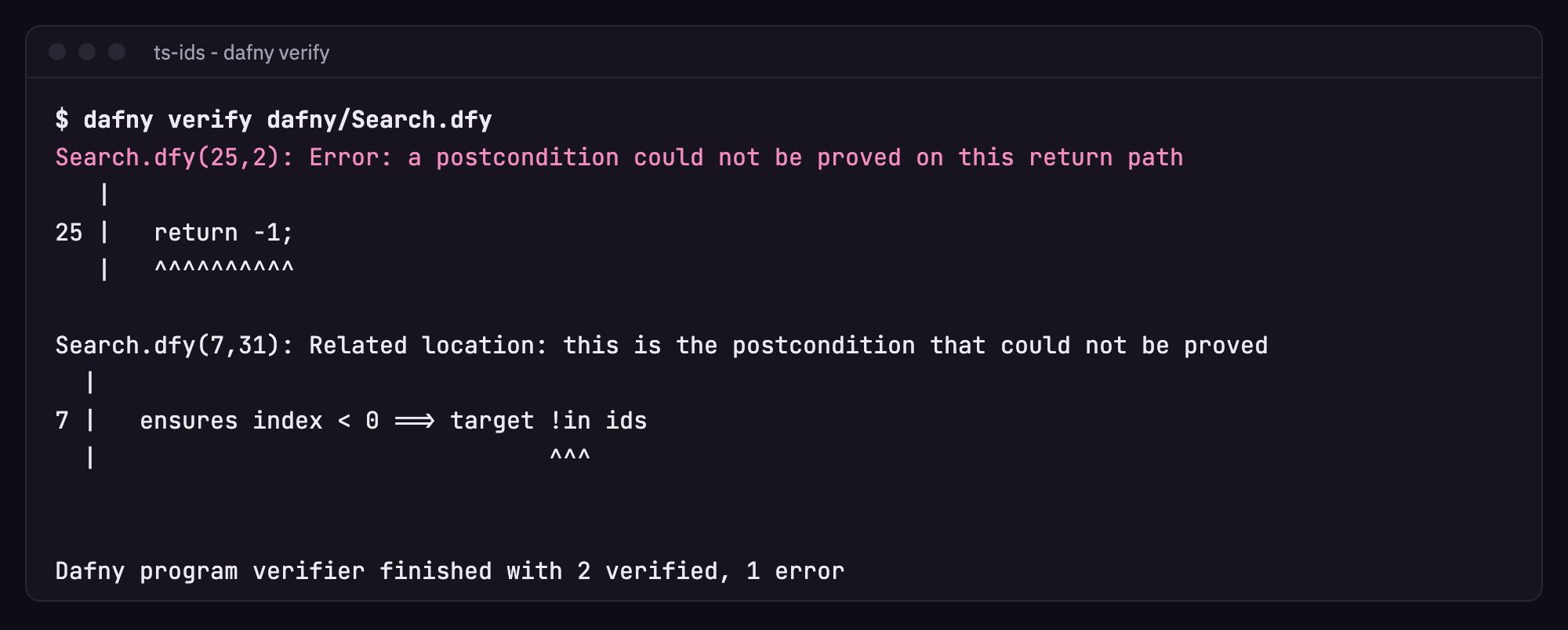
The range errors are gone. One error is left, and it is the real bug. When the loop ends, the invariants say
“everything before lo is too small, everything after hi is too big”. With while lo < hi, the loop can end with
lo == hi, and that one element was never checked. So Dafny cannot prove “the id is not in the list” at
return -1. It is right: the id might be exactly there.
Step 3: fix it
Section titled “Step 3: fix it”while lo <= hi fixes it: 0 errors, for every sorted list and every target.Keep looping while there is still something to check:
newtype int53 = x: int | -0x20_0000_0000_0000 < x < 0x20_0000_0000_0000
method IndexOf(ids: seq<int53>, target: int53) returns (index: int53) requires |ids| < 0x20_0000_0000_0000 requires forall i, j :: 0 <= i < j < |ids| ==> ids[i] < ids[j] ensures 0 <= index ==> index as int < |ids| && ids[index] == target ensures index < 0 ==> target !in ids{ var lo: int53 := 0; var hi: int53 := |ids| as int53 - 1; while lo < hi invariant 0 <= lo as int <= |ids| && -1 <= hi as int < |ids| invariant forall i :: 0 <= i < lo as int ==> ids[i] < target invariant forall i :: hi as int < i < |ids| ==> ids[i] > target { var mid := lo + (hi - lo) / 2; if ids[mid] < target { lo := mid + 1; } else if ids[mid] > target { hi := mid - 1; } else { return mid; } } return -1;}newtype int53 = x: int | -0x20_0000_0000_0000 < x < 0x20_0000_0000_0000
method IndexOf(ids: seq<int53>, target: int53) returns (index: int53) requires |ids| < 0x20_0000_0000_0000 requires forall i, j :: 0 <= i < j < |ids| ==> ids[i] < ids[j] ensures 0 <= index ==> index as int < |ids| && ids[index] == target ensures index < 0 ==> target !in ids{ var lo: int53 := 0; var hi: int53 := |ids| as int53 - 1; while lo < hi while lo <= hi invariant 0 <= lo as int <= |ids| && -1 <= hi as int < |ids| invariant forall i :: 0 <= i < lo as int ==> ids[i] < target invariant forall i :: hi as int < i < |ids| ==> ids[i] > target { var mid := lo + (hi - lo) / 2; if ids[mid] < target { lo := mid + 1; } else if ids[mid] > target { hi := mid - 1; } else { return mid; } } return -1;}newtype int53 = x: int | -0x20_0000_0000_0000 < x < 0x20_0000_0000_0000method IndexOf(ids: seq<int53>, target: int53) returns (index: int53)requires |ids| < 0x20_0000_0000_0000requires forall i, j :: 0 <= i < j < |ids| ==> ids[i] < ids[j]ensures 0 <= index ==> index as int < |ids| && ids[index] == targetensures index < 0 ==> target !in ids{var lo: int53 := 0;var hi: int53 := |ids| as int53 - 1;while lo <= hiinvariant 0 <= lo as int <= |ids| && -1 <= hi as int < |ids|invariant forall i :: 0 <= i < lo as int ==> ids[i] < targetinvariant forall i :: hi as int < i < |ids| ==> ids[i] > target{var mid := lo + (hi - lo) / 2;if ids[mid] < target {lo := mid + 1;} else if ids[mid] > target {hi := mid - 1;} else {return mid;}}return -1;}
newtype int53 = x: int | -0x20_0000_0000_0000 < x < 0x20_0000_0000_0000
method IndexOf(ids: seq<int53>, target: int53) returns (index: int53)  requires |ids| < 0x20_0000_0000_0000  requires forall i, j :: 0 <= i < j < |ids| ==> ids[i] < ids[j]  ensures 0 <= index ==> index as int < |ids| && ids[index] == target  ensures index < 0 ==> target !in ids{  var lo: int53 := 0;  var hi: int53 := |ids| as int53 - 1;  while lo <= hi    invariant 0 <= lo as int <= |ids| && -1 <= hi as int < |ids|    invariant forall i :: 0 <= i < lo as int ==> ids[i] < target    invariant forall i :: hi as int < i < |ids| ==> ids[i] > target  {    var mid := lo + (hi - lo) / 2;    if ids[mid] < target {      lo := mid + 1;    } else if ids[mid] > target {      hi := mid - 1;    } else {      return mid;    }  }  return -1;}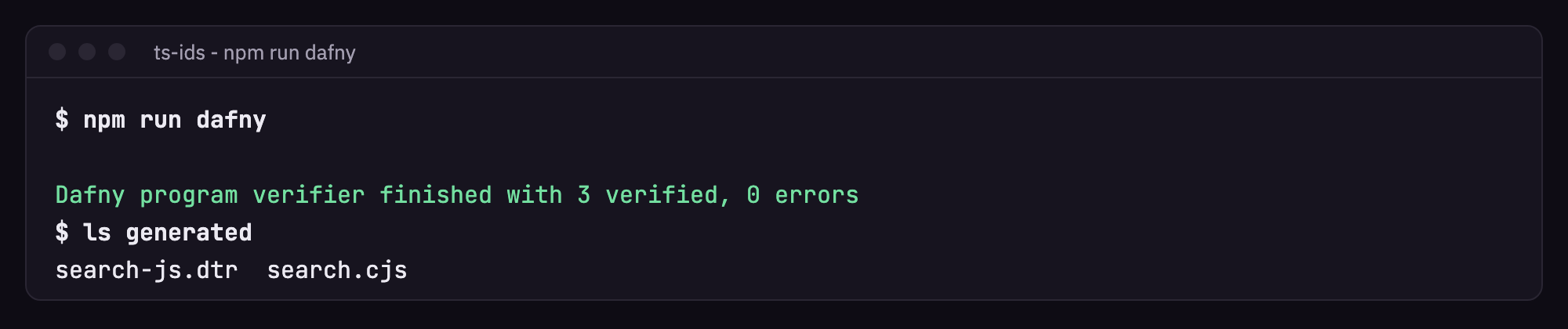
0 errors means both promises hold for every sorted list and every target, of any length.
Dafny also proves that the loop always ends. Change lo := mid + 1 to lo := mid, a common mistake, and it says so:
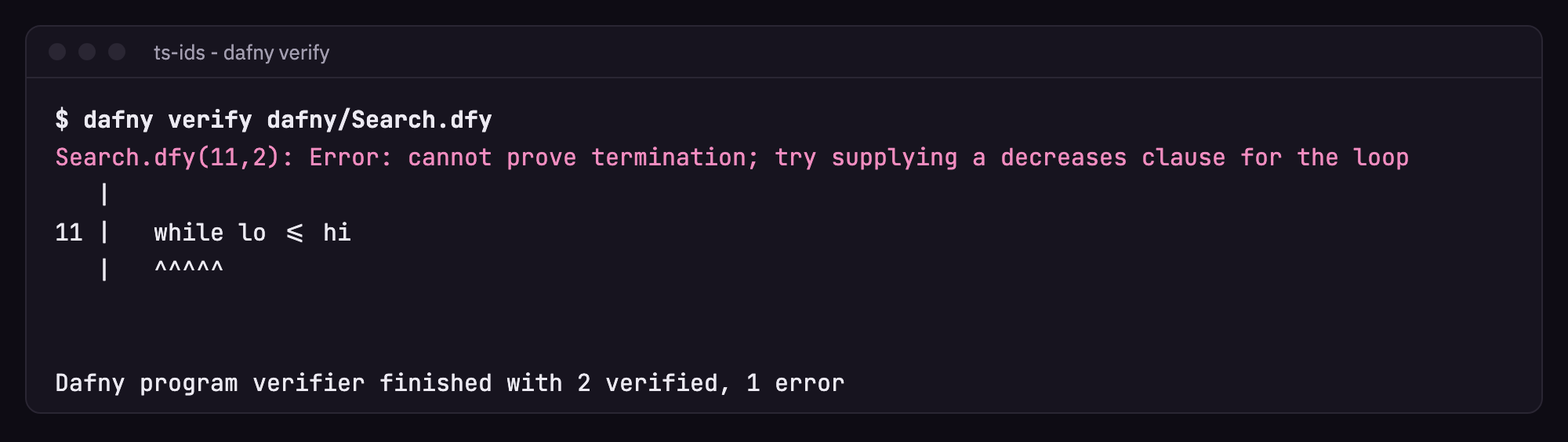
In TS that version hangs forever for some inputs. Here it does not compile.
Step 4: compile to JavaScript and use it from TS
Section titled “Step 4: compile to JavaScript and use it from TS”dafny translate js verifies, then writes plain JavaScript; a typed wrapper imports it into TS.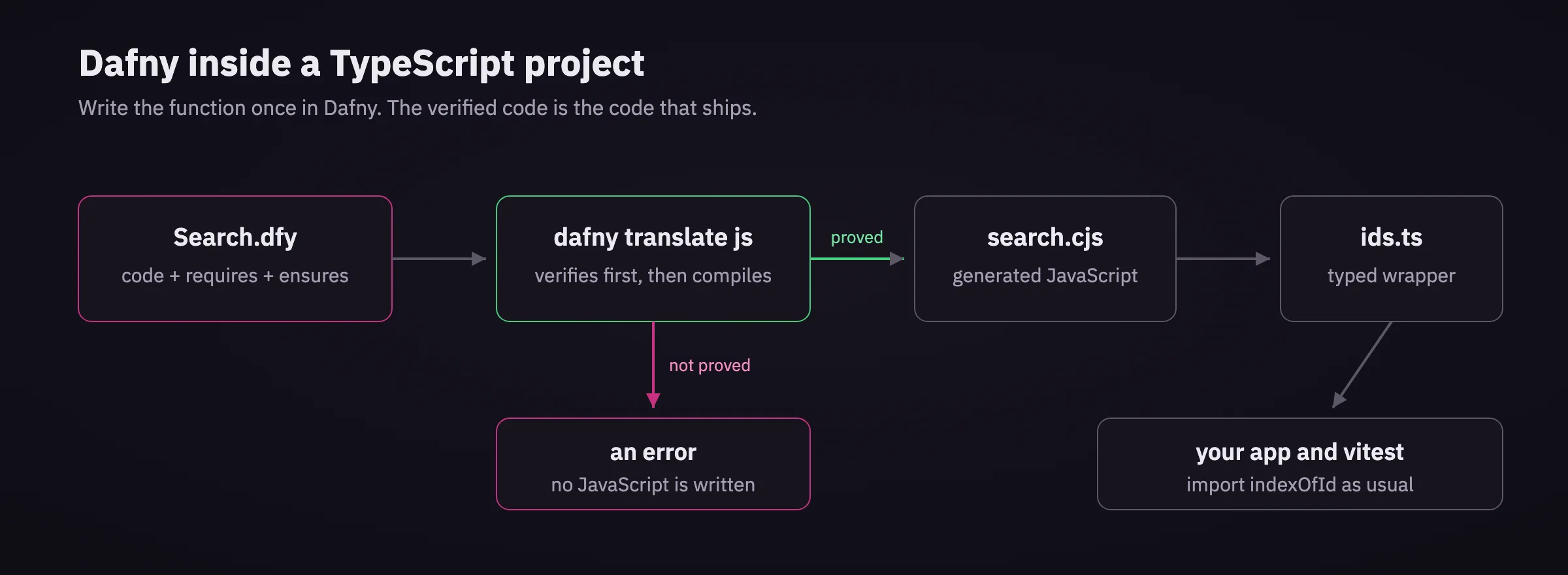
Add a script to package.json:
"scripts": { "dafny": "dafny translate js --include-runtime dafny/Search.dfy -o generated/search && echo 'module.exports = _module;' >> generated/search.js && mv generated/search.js generated/search.cjs"}dafny translate js verifies first. If there is any error, it stops and writes nothing.
The generated JavaScript has no types, so give it a two-line declaration file next to it. You write it once; the Dafny build leaves it alone:
declare const search: { __default: { IndexOf(ids: readonly number[], target: number): number } };export = search;Then src/ids.ts becomes one import and one line:
import search from '../generated/search.cjs';
export const indexOfId = (ids: readonly number[], target: number): number => search.__default.IndexOf(ids, target);
The rest of the app imports indexOfId exactly as before.
Add the edge cases to the tests:
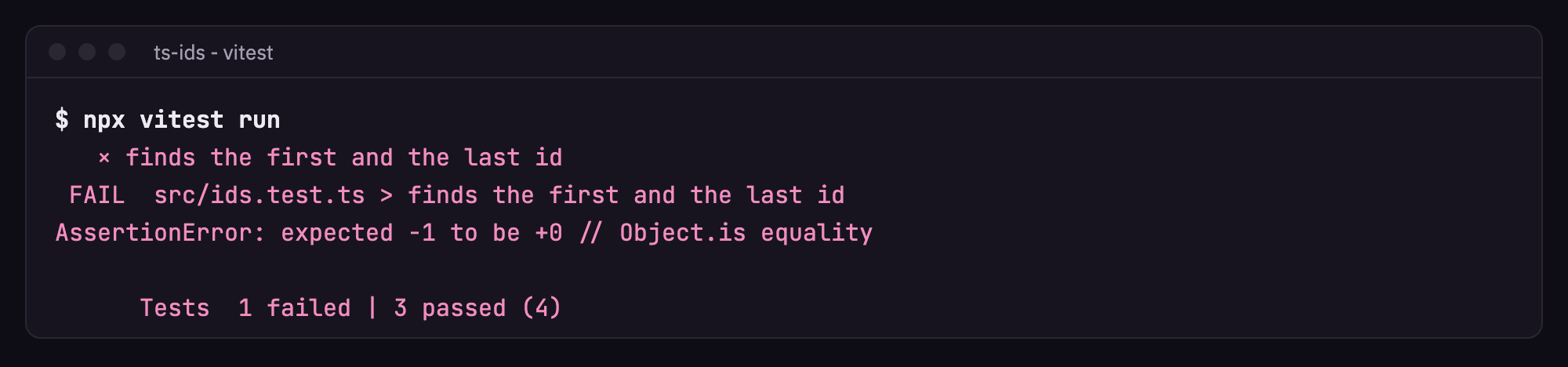
test('finds the first and the last id', () => {  expect(indexOfId([10, 20, 30], 10)).toBe(0);  expect(indexOfId([10, 20, 30], 30)).toBe(2);});
test('empty list', () => {  expect(indexOfId([], 10)).toBe(-1);});
Against the old TS function, the new test fails:
Against the Dafny build, all pass:
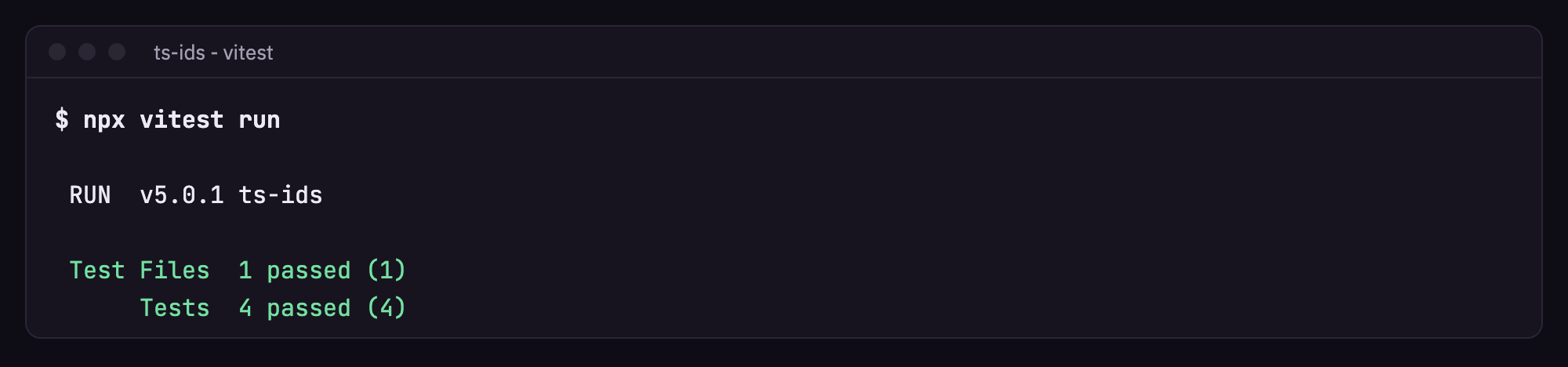
You still keep a few tests. They check the wiring (the wrapper, the export line, the import path), not the logic.
Project layout and CI
Section titled “Project layout and CI”generated/. CI verifies, regenerates it and fails on any difference.One repo. The Dafny source sits in its own folder, and the JavaScript it produces is committed next to it:
./├── .github/workflows/ci.yml├── dafny/│ └── Search.dfy the code, with requires / ensures / invariants├── generated/│ ├── search.cjs built from Search.dfy, committed, never edited by hand│ └── search.d.cts its types, written once by hand├── src/│ ├── ids.ts typed wrapper, the only file that imports generated/│ └── ids.test.ts tests for the wiring and a few edge cases├── .gitignore node_modules, generated/*.dtr├── package.json└── tsconfig.jsonWhy commit generated/:
- The app builds, runs and deploys with plain Node. Only the people who change
dafny/need Dafny installed. - The generated file shows up in code review, so a change in behavior is visible as a diff.
- CI can check that the committed file really comes from the committed, verified source. The build is repeatable:
the same
.dfyfile gives the same.cjsfile, byte for byte.
Scripts and dependencies in package.json:
"scripts": { "dafny": "dafny translate js --include-runtime dafny/Search.dfy -o generated/search && echo 'module.exports = _module;' >> generated/search.js && mv generated/search.js generated/search.cjs", "typecheck": "tsc", "test": "vitest run"},"dependencies": { "bignumber.js": "^11.1.5"}bignumber.js is a normal dependency, not a dev one: the generated code loads it at runtime.
The CI workflow has two jobs:
The CI workflow: .github/workflows/ci.yml (32 lines)
name: CI
on:  push:    branches: [main]  pull_request:
jobs:  dafny:    runs-on: ubuntu-latest    steps:      - uses: actions/checkout@v7      - uses: dafny-lang/setup-dafny-action@v1        with:          dafny-version: "4.11.0"      - name: Verify and regenerate the JavaScript        run: npm run dafny      - name: generated/ matches the verified Dafny code        run: git diff --exit-code generated/
  ts:    runs-on: ubuntu-latest    steps:      - uses: actions/checkout@v7      - uses: actions/setup-node@v7        with:          node-version: 24          cache: npm      - run: npm ci      - run: npm run typecheck      - run: npm test
What fails when:
| Change | Where CI fails |
|---|---|
A change to Search.dfy that Dafny cannot prove | dafny job, npm run dafny: the verifier error, no JavaScript written |
Search.dfy changes, generated/ is not rebuilt | dafny job, git diff: the committed JavaScript is stale |
Someone edits generated/search.cjs by hand | dafny job, git diff: the rebuild overwrites the edit |
| The wrapper or the import path breaks | ts job, tsc or ids.test.ts |
Making changes
Section titled “Making changes”ensures first, then the body; regenerate and commit both.Changing the search (for example, returning the insert position instead of -1):
- Change the
ensureslines first. They are the new promise, and the reviewer reads them before the code. - Change the body. Run
npm run dafnyuntil it verifies. If a loop fails, update the invariant: it should still be a sentence you can say out loud. - Update the types in
generated/search.d.ctsif the signature changed, and the tests that check the wiring. - Commit
Search.dfy,generated/andsrc/together.
Adding a function: add it to the same .dfy file (or include a new one), export it through the wrapper, regenerate.
One wrapper file per generated file keeps the untyped code in one place.
Reviewing a pull request: read the .dfy diff, starting with requires and ensures. Skim generated/. Its diff
only confirms the rebuild happened, and CI has already checked that it matches.
Strengths
Section titled “Strengths”- Shipped code is the proven code. The JavaScript is compiled from the
.dfyfile, so no hand-made copy can drift. - Proven for every input. Index access in range, loops that end, and every
ensureshold for all inputs. - Assumptions are written down. Hidden assumptions become
requireslines that the next developer can read.
Limitations
Section titled “Limitations”requiresis not checked at runtime. A TS caller can still pass an unsorted list. Check it once where the list is built.- Generated JavaScript. The output is readable but not hand-written. You edit the
.dfyfile, not the output. - Loop invariants take effort. Writing them is the main skill to learn. A failed invariant points at a line, which helps.
- One function at a time. Dafny does not cover timing, concurrency, I/O or the order of events between services.
How to start in your own project
Section titled “How to start in your own project”- Pick one small function with loops or index math, where a mistake is expensive.
- Write its promise as one sentence, then as
ensures. - Write what callers must guarantee as
requires. - Use limited number types like
int53so the output uses plain JS numbers. - When a loop fails to verify, write down what stays true on every pass. That is your invariant.
- Add the
dafnyscript, commit thegeneratedfolder, and wrap it with a typed TS function.
Related
Section titled “Related”- LemmaScript: writes the contracts as comments in the TS file and translates the function to Dafny or Lean for you, so you keep writing TypeScript.
- Dafny getting started
- Dafny reference manual
- Program Proofs, by Dafny’s creator, K. Rustan M. Leino: the book for programmers.